Where did the tokens go?
Agent HUD reads the records your agents already keep and shows where the tokens went: which agents, models, sessions and turns used them, and what the same work would cost at list prices. Quotas tell you how much is left. Token usage shows how it was spent.
Updated 2026-10-26
What can you track?
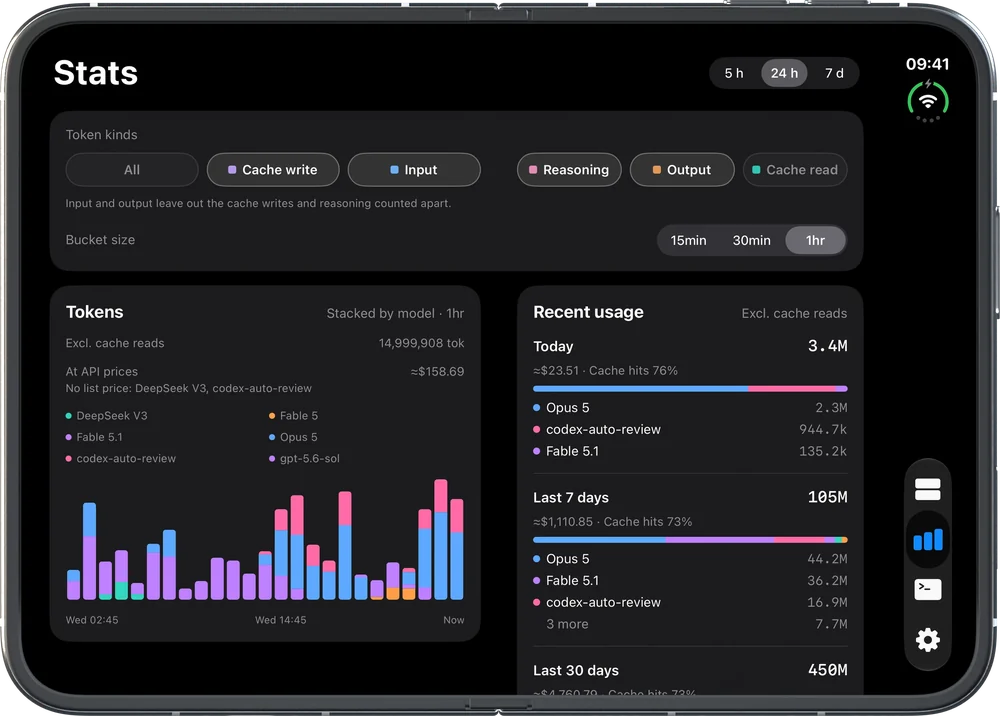
The numbers come from the records your agents keep on your computer. They cover nine dimensions.
| Dimension | What you can track |
|---|---|
| Time | The last 5 hours, 24 hours, 7 days or 30 days, in bars from 15 minutes to a day. History stays on your computer for 30 days. |
| Token kinds | Input, output, reasoning, cache writes and cache reads, all together or any mix. |
| Agents and models | Each agent's share, tokens and cost, and the models behind them. |
| Sessions | Tokens with the sub-agents' part, cost, turns, calls, context fill and cache hits. Sub-agents count inside the session that started them. |
| Turns and calls | The new tokens of every turn, and each call with its model, context and the tools it asked for. |
| Cache hits | Today, the last 7 days and the last 30 days, each session, and each model within a session. |
| Cost | An estimate at each vendor's list price, from its China or international price list, marked ≈. It is not a charge. |
| Activity | The hours your agents worked over the last 7 days. |
| Balances | DeepSeek's spend per day and the day its balance runs out. |
How are tokens counted?
Every call is split into five kinds: input, output, reasoning, cache writes and cache reads. Many logs count reasoning inside output and cached tokens inside input. Agent HUD takes them out and counts each kind on its own, so the five add up to the whole call and nothing is counted twice.
A response that a log records more than once is counted once.
| Kind | What it holds |
|---|---|
| Input | New prompt tokens that did not go through the cache |
| Output | The reply, without its reasoning |
| Reasoning | Output spent thinking before the reply |
| Cache writes | Prompt tokens written to the cache for later calls |
| Cache reads | Prompt tokens read back from the cache |
Why do the charts start without cache reads?
Cache reads are the context an agent reads back on every call. They grow with the length of a session more than with the work done in it.
So the token charts start with the other four kinds. They can also show all five, or any mix. When you compare two totals, compare them with the same kinds.
What do sessions, turns and calls show?
A session's tokens and cost include the sub-agents it started, and its page shows their part. Totals across agents count each sub-agent's log once.
For Claude Code, Codex and DeepSeek Harness, a session also breaks down by turn: the new tokens of each prompt, then every call that followed, with its model, its context and the tools it asked for. Context fill shows how close the session came to the model's context window.
Cache hits are the share of prompt tokens read from the cache. A call that had to write its context to the cache again is marked.
What does the cost mean?
The cost is an estimate: what the same calls would cost at the vendor's list price, from its China or international price list. It is marked ≈. It is not a charge, and it is not what a subscription bills.
Each kind is priced at its own rate, and each call at the price tier its prompt reaches. Yuan and dollar amounts are added up separately. A model without a list price adds nothing to the estimate, and the estimate's note names it.
For DeepSeek, which bills a balance, Agent HUD also shows the spend per day and the day the balance runs out.
Do tokens tell you how much quota is left?
No. A quota percentage is the vendor's own reading of your plan. Token counts come from the records on your computer. A large token total does not mean a quota is nearly used, and a small one does not mean much is left.
Where do you see it?
On the Mac, the HUD's hover panel shows the last 24 hours of tokens beside the quotas. The statistics window holds the charts, the activity hours and the split by agent and model, and every session has a page of its own.
iPhone and Apple Watch show token statistics, sessions and their tokens. When your iPhone is on the same network as the release on your Mac, this is free to use. Agent HUD Remote brings it to any network.
Your agents can ask as well. Agent HUD's built-in MCP server answers questions about usage, sessions and statistics from the data the app already holds.
Questions
Are reasoning tokens counted twice?
No. Many logs count reasoning inside output. Agent HUD takes it out of output and shows it as a kind of its own.
Is the cost what I will be billed?
No. It is an estimate at list prices, marked ≈. A subscription bills by its plan, and the vendor's own billing is the record of what you pay.
Which agents show turns and calls?
Claude Code, Codex and DeepSeek Harness. Every supported agent shows tokens and sessions; the supported agents table lists the rest of each one's coverage.
How long is token history kept?
30 days, on your computer.